Types of EMC Disturbances
2 min read
R
#EMC
#EMI
#Common-Mode Noise
#Hardware Design
1. Disturbance Classification Basics
In Electromagnetic Compatibility (EMC) design, understanding the mode of disturbance is a prerequisite for solving the problem.
- Differential-Mode Noise (DM): The current flows in opposite directions between signal/power line pairs, and the magnetic fields cancel each other out externally. Its radiation capability decays rapidly with distance, and it primarily dominates conduction interference in low-frequency bands.
- Common-Mode Noise (CM): The current flows in the same direction on multiple conductors, and the magnetic field phases overlap. It does not return through the intended path but instead utilizes the system ground, metal chassis, or spatial parasitic capacitance to return.
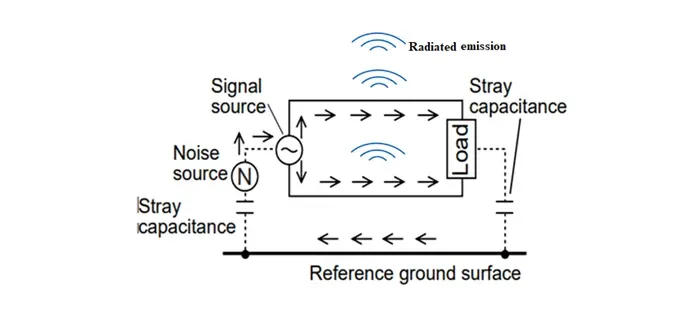
2. In-Depth Analysis of Common-Mode Disturbance Mechanisms
2.1 Pumping Effect in Switched-Mode Power Supplies (SMPS)
With the application of Wide-Bandgap (WBG) semiconductors (SiC/GaN), switching speeds have increased significantly.
- High-Energy Excitation: The extremely high voltage steps of GaN devices generate displacement current through parasitic capacitance .
- Key Coupling Paths:
- Power Devices and Heat Sinks: Parasitic capacitance between the drain/collector of the switching transistor and the grounded heat sink directly pumps high-frequency noise into the ground system.
- Isolation Transformer Windings: Interwinding capacitance across the isolation barrier allows noise to escape to the secondary output lines.
2.2 Mode Conversion and Harmonic Interference in High-Speed Data Interfaces
- 2.4GHz Band “Disaster Area”:
- USB 3.0/3.1: Its 5Gbps transmission rate uses NRZ encoding, with fundamental energy densely distributed near 2.5GHz. When combined with Spread Spectrum Clocking (SSC), it forms broadband noise that directly interferes with Wi-Fi and Bluetooth receivers, leading to desensitization (Desense).
- HDMI/PCIe: Extremely steep signal rising edges (picosecond level) produce rich high-order harmonics. If the differential pair has Signal Skew or trace mismatch, the differential-mode signal will largely convert into common-mode radiation.
- Key to Suppression: Connect Common-Mode Filters (CMF) with targeted 2.4GHz impedance in series on high-speed pairs and install shielding covers at the connectors.
3. Core Suppression Strategies and Engineering Implementation
3.1 Magnetic Components: Material Selection for Common-Mode Chokes (CMC)
- Manganese-Zinc (MnZn) Ferrite:
- Characteristics: High magnetic permeability, low electrical resistivity.
- Application: Focuses on 150kHz - 30MHz conducted interference; suitable for power input filters.
- Nickel-Zinc (NiZn) Ferrite:
- Characteristics: Low magnetic permeability, extremely high electrical resistivity (suppresses high-frequency eddy currents).
- Application: Focuses on 30MHz - 1GHz radiated interference; suitable for high-speed signal lines and RF circuits.
- Nanocrystalline: As an advanced solution, it possesses an extremely wide frequency response and high impedance, gradually replacing MnZn inductors in high-end power supplies.
3.2 Capacitor Networks: Return Path Restoration
- Y-Capacitors: Connected between the power line and the chassis ground. Essentially, they provide a local closed-loop, ultra-low impedance return shortcut for common-mode currents, preventing them from radiating through external long cables.
- Stitching Capacitors: Connected across split planes on the PCB. At high frequencies, they provide a continuous path for return charges of traces crossing the split, forcing potential common-mode radiation to be constrained as local differential-mode fluctuations.
3.3 Macro Protection: 360-Degree Grounding and the “Pigtail” Taboo
- The Hazard of Pigtails: A conductor produces approximately 20nH of inductance per inch. At high frequencies (>10MHz), this tiny inductance creates extremely high impedance, causing the shield to fail and transform into a radiating antenna.
- 360-Degree Circular Termination: Use metal cable glands (such as SKINTOP) or saddle clamps to ensure the shield makes full-circumference contact at the connector. This maintains the coaxial consistency of the transmission line and provides a near-zero inductance discharge path, which is the core guarantee for meeting CISPR 25 or military standard testing.
Recommended Standards:
- CISPR 25 / EN 55032